Monday, February 20, 2006 

Soup is Good Food

Hi there! This is my first entry here at the Food Docs since Chase invited me join her as a contributor. You can read a bit about my history with food here.

Alrighty, then! Let's get down to it.

One of the basics in my kitchen, indeed in any kitchen, and one of the first things I ever learned to make, is chicken stock. And as I am not only too cheap and have better standards than to buy the canned stuff at the grocery (though I have), it is, more importantly, nowhere near as tasty or as healthful as it is if you would make your own. And it's really easy too, if you've got a few hours to spare, with minimal pot-tending required. A lazy Saturday or Sunday afternoon would do just fine. You're just hanging around anyway, aren't you? And it makes your house smell really good to boot.

The ingredients:

  • Some chicken. It could be a whole fryer chicken, some leg and thigh pieces, some drumsticks, or even just some bone-on, skin-on whole chicken breasts, or a combination of all of those. Two or three pounds is about enough. And, if you're like me, take those little wing tips and necks and gizzards and such that you throw in the freezer for just these times and toss those in too.
  • A few unpeeled carrots, washed and chopped in half
  • A few stalks of celery, also just chopped in half or thirds to fit into the pot. It's fine to leave the leaves on.
  • An onion or two, skins on, cut into halves or quarters
  • A bay leaf or two
  • A good sprinkle of peppercorns
  • A few good sprigs of parsley


  1. Throw all the ingredients into a good sized pot and fill with cold water, about 1 1/2 or 2 quarts (six to eight cups). If your ingredients fill about 3/4 of your pot up, just fill the pot almost to the top with water. That's about the right proportion. This is not rocket science, just cooking.

  2. Place the pot over low heat and bring slowly up to a simmer. This is the only not-even-hard, but longish part of the process. It might take 30-45 minutes, depending on how big your pot is. The point of all this is that you want to slowly bring it to a simmer to extract all the flavor out of all the ingredients as you bring the water up to heat.

  3. Once it gets up to the point where you just see the faint bubblings of the simmer, you will notice some icky, grayish, foamy scum forming on the surface. Not to worry. Just get yourself a slotted spoon or something with holes in it, skim it off and discard it. This stage may take up to ten minutes or so.

  4. After all the scum (it's really just protein molecules or something) is gone, just let it all simmer at that really low point for about 2-2 1/2 hours. Never, ever bring it up to a full boil thinking that it will get done faster. It won't. Not only will your stock have less of that wonderful, rich chickeny taste, but it will make the end product cloudy rather than you ending up with that beautiful, golden color of a well-made stock.

  5. After the time is up, strain the chicken and vegetable pieces out and let cool for a bit. Discard the vegetables (or save them: I used to add these to our dog's food and she had the shiniest coat ever) and, when cool enough to handle, pull the chicken meat from the bones and store separately. Strain the stock through a fine sieve or colander to remove any other particles.

  6. Chill the stock overnight. If you live where it's cold in the winter
    (like me), stick the pot outside or in your garage overnight. The fat will rise to the top and solidify, and the next morning you can just pick it right off in chunks with a spoon. (If you make matzo balls, make sure to save some of this schmaltz for those. Otherwise, discard it.)


That's it! How easy was that? Notice that there was no salt added up to this point. There's usually enough added to the soups you make from this that I never add it when I make the stock.

Now you have a beautiful half-gallon, probably more, of homemade chicken stock. You can make some soup with it right now, which I heartily recommend, or freeze it for later use in any quantity you like. I usually freeze mine in 4-cup portions, which is just fine for two bowls whenever I get the urge for some good soup, which is about every other day.

Here are some things you can do with it:

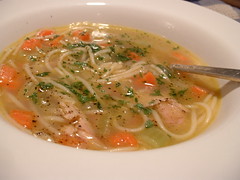
  • Basic Chicken Noodle Soup: Dice up some onion, carrots and celery and saute in a teeny bit of oive oil for five minutes. Add the chicken stock, bring up to a medium simmer and cook for 15 minutes. Add the noodles of your choice and cook, partially covered, for another 15 minutes or until noodles are done. (If you use spaghetti noodles or something similar, break them in pieces before adding. Rice would take at least 20 minutes.) Add as much of the reserved chicken meat as you like, either chopped or just torn into chunks, at this time too. Taste for seasoning, add some salt if needed, crack some freshly ground black pepper over, sprinkle with parsley and serve.

  • Mexican chicken soup: Bring the stock up to a simmer, add some drained black beans, drained canned or frozen corn, a can of undrained diced tomatoes (these even come in a Mexican style) and the reserved chicken meat. If I have zucchini I add that too. Garnish with sliced green onions, diced avocado, shredded cheese (cheddar or a Monterey Jack blend), and chopped cilantro. Instead of crackers I like to crumble some good tortilla chips in mine. Oh, and hot sauce, of course.

  • Italian tortellini soup: Simply cook your cheese or meat tortellini in the simmering stock until done. Grate some Parmesan cheese over it, and sprinkle with parsley and some freshly ground pepper.

  • Oriental chicken soup: Put a few slices of fresh ginger into your simmering stock (you will remove these later.) Add some sliced bok choy and your chicken, and some soba (or other) noodles if you like. Garnish with green onion sliced on the diagonal, cilantro, bean sprouts, and finish off with a few drops of dark sesame oil.


Chicken soup is one of the best things in the world. Make it your own, with whatever you have on hand. You can't ever go wrong.
Thursday, February 02, 2006 

My best Chocolate Chip Cookie recipe


For a long time I tried to make good chocolate chip cookies, to no avail, I couldn't get the tatse right. After much (and trust me, I'm talking years) time, I finally, finally got a recipe that I'm very happy with, and the best part is how simple it is to make.

I like mine with at least 2 cups or more chocolate chips, and Jessica likes here's with almost no chocolate chips, she just likes the cookie. It's all up to your taste. I've used macadamia nuts (awesome), butterscotch chips (my neighbor is still begging for more of those), white chocolate chunks (i love the white chocolate and macadamia together, yumm)


  • 1 cup granulated white sugar
  • 1 cup firmly packed light brown sugar
  • 2 sticks soft unsalted butter (take them out the night before)

  • 2 large eggs
  • 2 teaspoons pure vanilla extract

  • 2 1/2 cups all-purpose flour
    (if using self rising flour, omit baking soda & salt)
  • 3/4 teaspoon baking soda
  • 1/4 teaspoon salt

  • 1 cup - 1 - 2 cups semisweet or milk chocolate chips
  • 1 cup of preferred chopped nuts (optional)


Preheat oven to 350 degrees F (177 degrees C)
place rack on center holder

I use cookie sheets with wax paper, or non stick cookie sheets

Using a mixer or by hand, stir your soft butter in a bowl until creamy (30-50 strokes if by hand. 1 minute if by mixer) Add brown & white sugars and beat until fluffy (about 2 minutes). Beat in eggs, one at a time, making sure to beat well after each egg. Add vanilla and beat until mixed in.

In a separate bowl, mix together your flour, baking soda, and salt. If you are using self rising flour, there's no need for a seperate bowl.

Add flour to the sugar/egg mixture and beat until well mixed.

Add your chips, nuts, or other extras, and mix just until incorporated.

For regular size cookies, use 1 tbs dough
for larger cookies, use 2 or 3 tbs dough
Set cookies about 2 inches apart

If dough is too soft, put in fridge for 30 min.

Bake about 12 - 14 minutes (check for light brown around edges)
Cool completely on flat surface, wire rack, or if using multible sheets, cool on sheet


Cookies come out somewhat crunchy when cooled. If you keep the cookies in the oven a few minutes longer, they will be crunchier (the way I like them). Once they are cool, store them in an airtight container to keep them crunchy. If you leave the lid loose on the jar, or have the cookies loosely covered they will get chewier as the days pass (that is if you're able to keep them that long, lol. This recipe makes a couple dozen cookies. Also, you can freeze the dough, by forming tsp of dough into balls, put them on a nonstick or wax paper lined cookie sheet and freezing them, after they are frozen, put them in a ziplock until you're ready to bake them. When you're ready to make some cookies, just bake as normal, increasing baking time by a minute or two.

Make sure you let me know how they come out if you try them, ok?

Friday, January 27, 2006 

The Perils and Joys of RICE

Eaten all over the world, rice is a good source of B vitamins such as thiamin and niacin, it also provides iron, phosphorus, and magnesium. Its protein quality is good because it contains relatively high levels of the amino acid lysine (but it is lower in protein than other cereal grains). It is a good source of B vitamins, such as thiamin and niacin, and also provides iron, phosphorus, and magnesium.

In some languages, the word for eat means "eat rice", but rice had always been my nemesis. No matter how hard I tried, it was either too soft, the bottom was burnt, or it was too hard (not fully cooked). Much of this had to do with measurements. No matter that I did what the box said, or what someone else had told me, I couldn't get it right. Sometimes it had to do with the heat, not high or low enough. After much trial and error, I finally figured out how to make it perfect, and have been doing so for the past 10 yrs or so.

In most parts of the world rice is milled and polished to remove the bran and germ, but this is also the part that contains the valuable nutrients. In the US, white rice is enriched with two B vitamins, thiamin, niacin and iron. But in many countries enrichment is not a common practice, which results in many nutrient-deficiency diseases.

Rice Sizes: long-grain, medium-grain, and short-grain.

Long-grain rice accounts for about 75% of the domestic crop. The slender grains are four to five times longer than they are wide. If properly cooked, they will be fluffy and dry, with separate grains.

Medium-grain rice is about twice as long as it is wide and cooks up moister and more tender than long-grain. It is popular in some Asian and Latin American cultures, and is the type of rice most commonly processed to make cold cereals.

Short-grain rice may be almost oval or round in shape. Of the three types of rice, it has the highest percentage of amylopectin, the starch that makes rice sticky, or clump together, when cooked. Easy to eat with chopsticks, it is ideal for dishes like sushi.


Rice Types:

Enriched rice: Enriched rice has thiamin, niacin, and iron added after milling to replace some of the nutrients lost when the bran layer is removed. As a result, it is higher in these nutrients than brown rice.

Converted rice: Converted rice has been soaked and steamed under pressure before milling, which forces some of the nutrients into the remaining portion of the grain so that they are not completely lost in the processing. Enriched parboiled rice is similar to regular enriched rice in terms of thiamin, niacin, and iron, but it has more potassium, folate (folic acid), riboflavin, and phosphorous, though not as much as brown rice. Converted rice takes a little longer to cook than regular rice, but the grains will be very fluffy and separate after they have been cooked.

Instant white rice: Instant rice, which actually takes about five minutes to prepare, has been milled and polished, fully cooked, and then dehydrated. It is usually enriched and only slightly less nutritious than regular enriched white rice, but it lacks the satisfying texture of regular rice.


Nutrition Chart

White Rice/1 cup cooked

Calories 205
Total fat (g) 0.4
Saturated fat (g) 0.1
Monounsaturated fat (g) 0.1
Polyunsaturated fat (g) 0.1
Dietary fiber (g) 0.6
Protein (g) 4
Carbohydrate (g) 45
Cholesterol (mg) 0
Sodium (mg) 2
Thiamin (mg) 0.3
Folate (mcg) 92
Manganese (mg) 0.8
Selenium (mcg) 12


My perfect measurement is 1 part rice to 2 parts water. Meaning, if you use one cup of rice, use two cups of water.*

1/2 cup rice = 1 cup of water
2 cups rice = 4 cups water

*A half cup of rice is enough for one or two people, depending on how much you consider one serving, and a cup can be enough for 2 to 4 people, again, depending on serving size.

You can use long or short grain, although I prefer long.

When cooking

  • You want a medium heat, you don't want a rapid/heavy boil, but a soft boil
  • Keep the lid tight and try not to open it too many times
  • Heat your pot, let the pot get hot, add two tbs of olive oil (or butter)
  • Add the rice, stir, then add water (hot or cold)
  • Put lid on and let cook
  • Times will vary, depending on how much rice, a cup is about 15-20 min.
  • Try to use a pot, not a flat pan.


After doing this a number of times, you will know how to tell when the rice is done. It may be the holes in the top of the rice, a certain dryness to the rice on top. Hopefully it won't be by the burning smell too many times, lol.

Fluff rice with a fork before serving, no matter which cooking method you've chosen. For drier rice, fluff it, then cover the pan again and let it stand for 10 to 15 minutes. Consider cooking more rice than you need for a meal, as it reheats well if you add a few tablespoonfuls of extra liquid. Cooked rice will keep for about a week in the refrigerator.


The best thing about rice is it's versatility, you can add it to almost anything, and you can add almost anything to it. Here are some examples.


Rice Omeletts/Omerice - Is a traditionally Japanese dish. Rice and egg are a suprisingly good combination. We all know about egg in our chinese fried rice, but you can also add rice to omeletts, for a breakfast, brunch or anytime treat.

Omelette : mix 2 eggs in a bowl with 4 teaspoons of milk, season to taste*

(season to taste means, add a pinch of the seasonings you like, I add a little pepper, a little adobo, a little chili powder and a little parsley)

Then I take a 1/2 cup of cooked rice (maybe from last nights dinner, throw it in a greased or nonstick pan, with a little meat from last nights dinner (chicken, ham, pork chop, turkey, steak, meatball, etc), you can add some chopped onion, bell pepper, heat through. You can add just the rice and cheese, just the rice and onion...or any combo you like.

Now the next step can be done one or two ways.

Myself, I take the egg and pour it over the filling, let it cook until the egg is firm enough to fold, add a slice of cheese and then fold it. Some people prefer to take another pan, heat it, grease it, put the egg in, swirl it around to cover the pan, then put the fillings in, let the egg cook till firm, then flip it in half (adding cheese if you like).

Either way is fine, and as with anything...the more you do it, the better you'll get at it, and the more you will adjust the recipe to suit your taste.

When you adjust a recipe to suit your taste, it now becomes YOUR recipe!


More Rice combos:


  • add chicken bouillion (cubed or powdered)or a packet of Sazon (which maked the rice yellow). Both give the rice so much flavor, you won't need butter. Good for dieting.

  • Stuffed peppers (recipe to come)

  • add canned beans (pinto, kidney, pidgeon, peas...almost any)(rinse them first)

  • add chopped onion or bell pepper

  • add chopped spinach


Rices are also labeled according to variety:

Arborio: Arborio is a starchy white rice, with an almost round grain, grown mainly in the Po Valley of Italy. Traditionally used for cooking the Italian dish risotto, it also works well for paella and rice pudding. Arborio absorbs up to five times its weight in liquid as it cooks, which results in grains of a creamy consistency.

Aromatic rices: These are primarily long-grain varieties that have a toasty, nutty fragrance and a flavor reminiscent of popcorn or roasted nuts. Most of these can be found in grocery stores, but a few may be available only at gourmet shops.

Basmati: Basmati, the most famous aromatic rice, is grown in India and Pakistan. It has a nutlike fragrance while cooking and a delicate, almost buttery flavor. Unlike other types of rice, the grains elongate much more than they plump as they cook. Lower in starch than other long-grain types, basmati turns out flaky and separate. Although it is most commonly used in Indian cooking, basmati can also be substituted for regular rice in any favorite recipe. It is fairly expensive compared to domestic rice.

Glutinous rice (sweet rice): Popular in Japan and other Asian countries, this type of short-grain rice is not related to other short-grain rices. Unlike regular table rice, this starchy grain is very sticky and resilient, and turns translucent when cooked. Its cohesive quality makes it suitable for rice dumplings and cakes, such as the Japanese mochi, which is molded into a shape.

Jasmine: Jasmine is a traditional long-grain white rice grown in Thailand. It has a soft texture and is similar in flavor to basmati rice. Jasmine rice is also grown in the United States, and is available in both white or brown forms.

Texmati: Certain types of rice--some sold only under a trade name--have been developed in the United States to approximate the flavor and texture of basmati rice. Texmati is one of these; it was developed to withstand the hot Texas climate (there is also a brown rice version).

Wehani: An American-grown aromatic rice, Wehani has an unusual rust-colored bran that makes it turn mahogany when cooked.

Wild pecan (popcorn rice): Another basmati hybrid, this aromatic rice is tan in color (because not all of the bran has been removed, with a pecanlike flavor and firm texture.


If you have any questions, please feel free to leave a comment, ask any questions.
Questions will help me know how to explain things better.

Remember, two things:

The only dumb question is the one you don't ask.
There's no such thing as a bad cook, only an uneducated and unpracticed one. Practice makes perfect and the more you cook, the better you will get at it.

I promise!


Spagetti Squash

I had heard about this mythical vegetable that turned into spagetti-like strands and was only 75 calories for an 8 oz serving. One day I decided to give it a try, and wound up adding a wonderful new veggie to my cooking repertoire.

Ss is very easy to cook, you can boil or bake this mild tasting veggie. I like baking better, as it retains more of its natural flavor this way. You can even microwave it if you're time-challenged!

Simply cut the squash in half, use a spoon and scoop out the seeds, try not to remove any of the meat.

Boil: place both halves in pot cover with water, boil till tender

(The shell will never get totally soft, so when I say tender, i mean the insides will be well cooked)

Bake: place halves in buttered/greased baking dish, bake at 350f for 60-70 minutes until tender

Micro: Prick whole squash with a sharp knife. Place uncut squash in a microwave-safe baking dish. Microwave, uncovered, on 100% power (high) for 15-20 minutes or til tender. Let stand 5 minutes. Halve squash lengthwise and remove seeds.

After your choice of cooking, simply take a fork and run it thru the meat of the squash and the spaghetti-like strands will come out. Really! It's that simple! You can remove the meat all the way down to the shell.


You can add your favorite spaghetti sauce on top, just as you would with pasta, you can just add butter and a pinch of salt (my fav), alfredo sauce, grated cheese, be adventurous.

Keep in mind, one squash makes a LOT more strands than you would expect, but it will keep in the fridge for a few days and tastes great cold, tossed with fresh chopped tomatoes, a light vinaigrette, with salad or alone.


I like to cut up some roma tomatoes, toss them with olive oil, chopped garlic, chopped onion, a tsp of adobo, a handful of basil and parsley chopped, and put it in the oven while the squash is roasting (keep an eye on it so the bottom doesn't burn). When the tomatoes are soft, take it out and scoop it over your spaghetti squash (I like to mash it a little, but you can leave it chunky)

If you're brave and like the rustic look, you can serve your spaghetti squash recipes right in the shell!!


Here's a great Kraft Spaghetti Squash recipe that a friend of mine swears by. I'm going to try it one day and give my thoughts on it. It seems like a bit much to me, I kind of like to keep it simple, the squash....a little butter and parsley and I'm good. :)


Cheesy Spaghetti Squash

Prep Time: 10 min
Total Time: 27 min
Serves: 6, about 1/2 cup each

Ingredients:
1 spaghetti squash (3 lb.)
2 Tbsp. KRAFT Reduced Fat Parmesan Style Grated Topping
1/2 cup KRAFT 2% Milk Shredded Reduced Fat Mozzarella Cheese
2 plum tomatoes, chopped
1/4 cup chopped fresh parsley


Preparation:
Pierce squash several times with a fork or sharp knife to allow steam to escape. Microwave on HIGH for about 10 minutes or until soft, turning over after 5 minutes. Let stand 5 minutes. (or you can bake or boil the squash)

Cut squash in half. Remove and discard seeds. Use a fork to scrape the insides of the squash to form strands. Toss squash strands with grated topping, mozzarella cheese, tomatoes and parsley.

Spoon squash mixture back into shell. Microwave on HIGH for 2 minutes to heat through.

(Nutrition (per serving), Calories 100, Total fat 3 g, Saturated fat 1.5 g, cholesterol 5 mg, Sodium 170 mg, Carbohydrate 15 g, Sugars 7 g)


Spaghetti Squash Pancakes or Veggie Potatoe Pancakes

6 C spaghetti squash, cooked and separated into strands
1/3 C all-purpose flour
1/2 C grated Parmesan cheese
4 T butter or olive oil
salt and pepper to taste
sour cream and apple sauce for garnish

Serves 6-8 as a side dish or appetizer

Add flour & cheese to the strands of the cooked spaghetti squash. Mix well, using a couple of forks.

Depending on the flavor you wish, or your dietary preferences, melt 1 tablespoon butter in a large skillet over medium-high heat or heat olive oil in skillet instead.

Spoon 1/4 cup squash mixture into prepared skillet. With a fork, press to form an evenly thick cake. Repeat to fill skillet. Cook cakes until bottoms are lightly browned, turn over and brown second side. Continue until you've used all the squash mixture keep the cakes already made warm in an oven set at its lowest temperature until you are ready to serve). Use additional butter or oil as necessary for cooking. Sprinkle pancakes with salt and pepper and serve with sour cream and/or apple sauce.

About Us

  • We're: Food Docs
  • Contributors:

    ....Chase
    ....Peggy

  • About Us: We've been cooking all our lives, and if we can share some of what we've learned along the way, then our job is done. There is no such thing as a person who cannot cook, only someone who doesn't know how. The good news is, it means you can learn. We've got the cure for that nasty "Iburnwater-anitis", we're the Food Docs, and we're here to help.

    Please feel free to suggest articles, or ask any question, and of course we welcome your comments, especially if you've tried one of our recipes!

Food Docs Store

    Wanna support The Food Docs? Just take a look at some great cooking items. Our current special is our Hot n Spicy Collection, great items, awesome prices, and you can safely and easily pay for your items thru paypal and/or credit card, even if you don't have a paypal account! Muy Caliente!

    If you are located outside of the US please email us before ordering for oversea shipping cost.
    Email our store if you have any questions, or would like our catalog of over 5000 items!

    These bright red chili salt 'n pepper shakers are so spicy they practically burn a hole through your table! Hand wash only. Stoneware. 3 5/8" x 2" x 2 1/4" high. 12.95


    Make your morning coffee a fiesta with this spicy hot 12 oz mug! Earthenware. 3 1/8" diameter x 3 7/8" high. 7.95


    Add some spice to your dish with this generously sized, vivid red pepper platter. Hand wash only. Stoneware. 15 1/4" x 8 3/4" wide. 24.95


    These finely woven placemats in hot striped colors give an extra zesty kick to your meals. 100% cotton. 19 1/2" x 13" wide. set of 4 - 12.95


    These fiery southwestern stripes add colorful fun to your dinner table. 100% cotton. 17" x 16" wide. set of 4 - 11.95


    Your tortillas stay extra toasty in this south-of-the-border style warmer. Microwave and dishwasher safe. Earthenware. 9" x 9" x 3 5/8" high. 19.95


    A red hot decoration for your stovetop that also saves it from messy spoon splatters. Dishwasher safe. Earthenware. 9 1/4" x 5 1/4" x 1 1/2" high. 9.95


    A bevy of spicy peppers dance on side of this exciting utensil holder! Dishwasher safe. Earthenware. 4" x 4" x 6 1/4" high. 12.95


    Festive napkin holder brings south-of-the-border fun to your kitchen table. Earthenware. 5 1/4" x 2 1/2" x 3 1/4" high. 6.95


    Pour a cool glass of lemonade from this stylish and peppy pitcher. Dishwasher safe. Earthenware. 8 1/2" x 6 1/2" x 9 1/8" high. 26.95


    A hot chili is the handle for these three bowls designed for your most tongue-tingling dipping sauces. Microwave and dishwasher safe. Earthenware. 9 1/4" diameter x 4 3/4" high. 16.95


    Add a colorful accent to your table— without adding water! Artificial chili plant with bright red chiles in a terra cotta pot. The pot is 4 1/2" in diameter. 9.95

    Use this button to check your cart, add/remove items, check your total or to finish shopping.


    If you would prefer to make a donation, regardless of how small, click this button:

Powered by Good Food!
and Blogger Templates